Careful examination of how the different senses operate reveals what they share in common and allows us to draw parallels between the corresponding perceptions.
The human ear can perceive roughly 10 to 11 octaves (about 20 Hz to 20 000 Hz). From one octave to the next, sound frequencies double.
Ear and Sound Waves
The ear is sensitive to the various frequencies of sound waves.
Functioning of the Ear
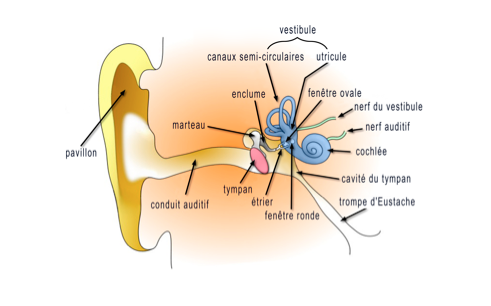
In the middle ear, the ossicles—the malleus (hammer), incus (anvil), and stapes (stirrup)—transmit air vibrations. The stapes strikes a membrane behind which lies the cochlea, a spiral-shaped tube lined with sensory cells along its membrane. Together, this membrane and its cells form the organ of Corti. The organ of Corti performs a frequency analysis of incoming sound waves based on resonance. Specifically, outer hair cells amplify incoming vibrations, while inner hair cells, equipped with stereocilia, resonate at different sensitivities depending on their position in the cochlear canal: high frequencies stimulate the base, low frequencies the apex—much as retinal cones respond to different light wavelengths. These hair cells connect to nerve fibers, converting mechanical vibrations into nerve impulses. Note that our perception of sound also relies on mental reconstruction driven by the combination of detected frequencies.
Processing of Sound Information
Musical information appears to be processed at several levels:
- Perceptual Level
In the auditory cortex, we register raw sound waves. Their vibrations also stimulate tactile receptors in the skin and internal receptors in the viscera, producing the raw auditory experience. - Emotional Level
Involving the hippocampus, this level underlies the phenomenon of “musical chills.” It links a sound experience with past memories—echoes of similar melodies or musical moments (sometimes from childhood) tied to emotions. - Cognitive Level
The highest level arises from learning and decoding the music. It requires education and musical understanding, giving rise to the connoisseur’s pleasure.