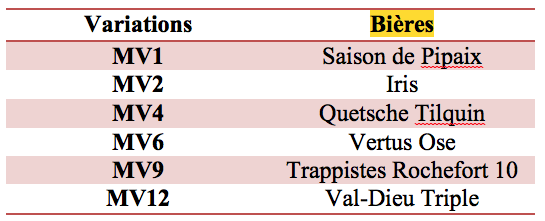
Regional Belgian beers associated to Mozart’s variations (K 265)
Where can this kind of association be found?
To associate music and odors is not very frequent. Local experiments do exist where wine tastings are coupled with the listening of music in an attempt to match wines and particular musical excerpts (concertos for wine and voice organised by Gwendoline Spies, for instance). The coupling is normaly done in a subjective way.
How to quantify odors?
A way to start is to take evaluations of beers or wines for instance carried out by experts. Typically, the flavors are assessed along a limited number of dimensions like sweetness, bitterness, length in the mouth, alcohol level. A matrix of dissimilarities between the different flavors can then be defined by taking the Euclidean distances in the space defined by the criteria. This has been done to elaborate the table given above. 20 regional beers have been evaluated along 7 criteria by a Begian expert, Christophe Gillard.
How to quantify music?
Musical pieces must be cut into a limited number of segments (typically 5 to 50 depending on the length of the piece). In the given exemple, the first 8 bars of each variation of Mozart define a segment. The segment are then digitalized by computing Mel Frequency Cepstral Coefficients.This makes it possible to define distances between segments and to map them on beers.
How to map music and odors?
The elements from the two sets (beers and variations) are mapped in a way which preserves the distances in each space as far as possible. Some variations were selected a priori : the original theme (MV1) plus the variations 1 (MV2) , 3 (MV4) , 5 (MV6) , 8 (MV9) and 11 (MV12). They constitue the target set. The space of beers is then searched to find a configuration of 6 beers which corresponds to the 6 variations. The search is carried out with our mapping device.