Careful examination of how the different senses operate highlights what they share in common and makes it possible to draw parallels between their corresponding perceptions.
The Eye and Colors
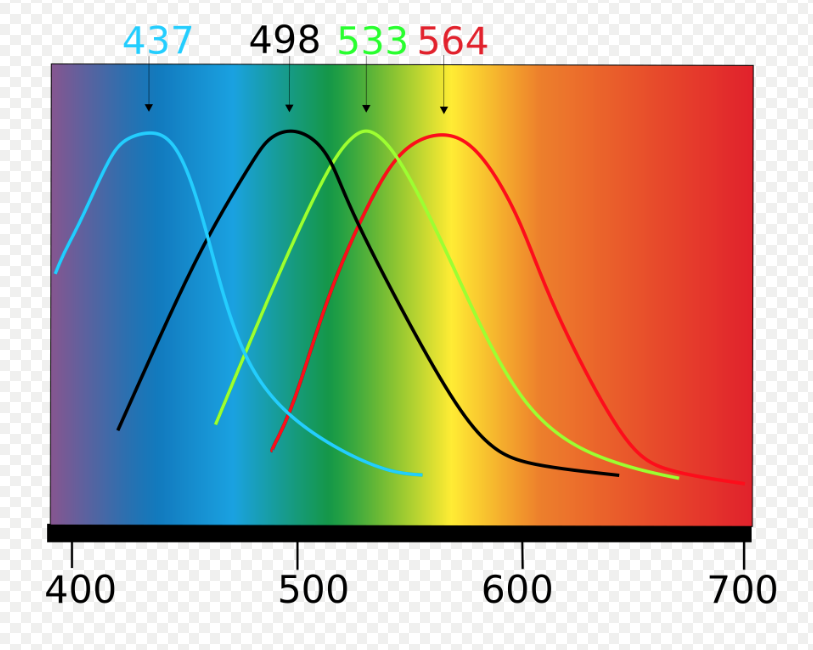
Photoreceptors at the back of the eye (cones and rods) are sensitive to different frequencies and intensities of light waves and generate color perceptions by combining their signals. Three types of cones exist, each tuned to a distinct frequency band (corresponding to red, green, and blue sensations). But the colors we perceive are not mere visual translations of specific wavelengths. For example, a 0.56 μm light vibration will stimulate both red-sensitive and green-sensitive cones equally, producing the perception of yellow. In this case, there genuinely is a single wavelength whose frequency elicits the impression of yellow.
By contrast, violet perception works differently. It requires simultaneous stimulation of blue-sensitive and red-sensitive cones, yet no single wavelength activates both receptor types at once. Violet light must therefore be a hybrid, combining multiple wavelengths. Unlike yellow, it does not correspond to a unique wavelength.
Colors are thus mental constructions arising from the combined activation of three receptor types, not simple recodings of distinct vibration frequencies.
Processing of Visual Information
Photochemical activation of retinal cells generates electrical potentials that are then processed to produce depth effects via stereoscopic construction, contrast enhancement to extract shapes, and other formal features. These preliminary schematic views are formed before higher-order visual representations are activated.
The human eye can distinguish between 180 and 200 different shades.