

The aim is to represent a melody in a geometric space.
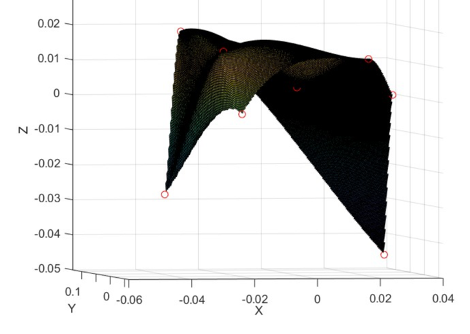
Representation of the melody “Zu Arel op der Knippchen”
- A melody as a sentence
In this project, a melody is approached as a sentence, whose words are the notes. Each note has an identity defined by its pitch and its position in the melodic line. To simplify the analysis, all notes are given the same duration here.
- Semantic embedding of notes
Each note is then transformed into a vector in a reduced-dimensional space. This operation uses artificial-intelligence techniques inspired by language processing: in the same way that a word can be embedded in a semantic space (word embeddings), a note can be embedded in a latent space that encodes, for example:
- its proximity to other notes;
- its role in the melody;
- its contribution to the musical structure.
This produces a geometric map of the melody: a sequence of points in a multidimensional space. I generally work with two- or three-dimensional vectors.
- Building a contour: triangulation and principal component analysis
From these points, I construct a surface that envelops the melodic trajectory (see the graph above). To do this, I use:
- triangulation techniques;
- principal component analysis to stabilise the surface orientation;
- geometric smoothing to obtain a continuous form.
This surface is a geometric fingerprint of the melody.
- Exporting to Fusion 360
The resulting surface is then exported to 3D modelling software. In this environment, it becomes a manipulable object that I can:
- thicken;
- extrude;
- cut;
- integrate into more complex volumes.
- Cutting prisms: the cross-section as a representation of the melody
The surface then serves as a cutting plane for prisms. The resulting cross-section is a geometric representation of the melody: a form that is neither a score nor a spectrogram, but a spatial translation of its semantic content.
This cross-section is:
- sensitive to variations in the melodic line;
- influenced by the internal structure of the musical phrase;
- unique to each melody.
- A musical sculpture
The final result is a sculpture: a form that condenses the melody into a visual and tactile space. It can be:
- displayed;
- animated;
- 3D-printed;
- used as a basis for artistic or educational explorations.
- The Zen garden: an example of these techniques in use
I created a Musical Garden from an excerpt of F. Chopin’s Étude, Op. 10 No. 3 (“Tristesse”) (a public-domain recording made available through Musopen.org).
The same excerpt was performed several times, producing different volumes for the same sequence of notes. They are arranged in a Zen garden on a bed of raked pebbles.
A place of silence and contemplation, the garden welcomes these forms and invites the eye to linger on them.
Here, music becomes landscape.